
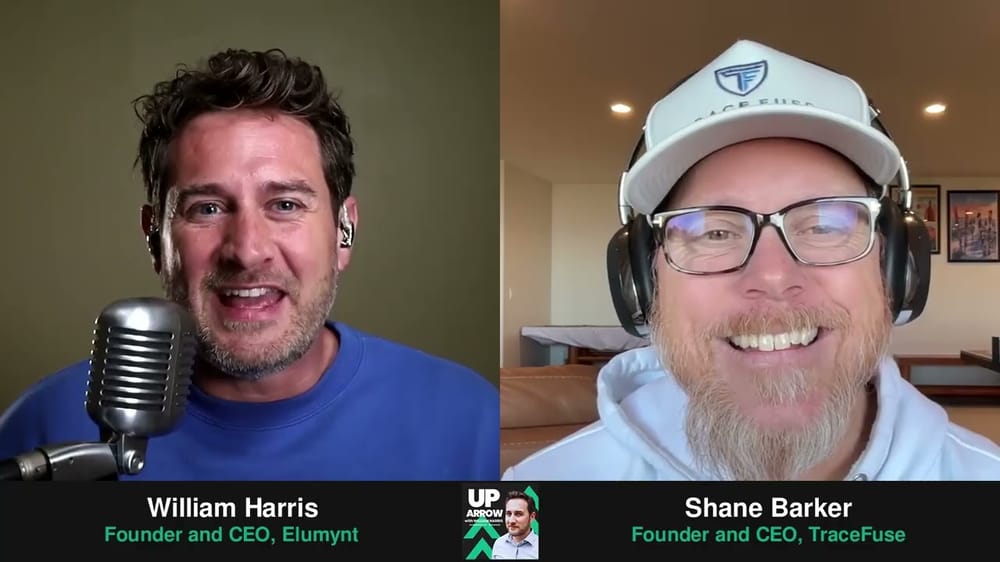
When you've spent 25 years in digital marketing, you think you've seen it all. But nothing prepares you for a $60 million lawsuit that freezes your accounts and puts your reputation on trial across the internet. That's exactly what happened to Shane Barker, a veteran digital marketer and my guest on a recent episode of the Up Arrow Podcast. What started as a personal crisis for Shane ultimately led him to become a leading expert in reputation management, helping everyone from celebrities to e-commerce brands navigate the tricky waters of public perception.
A $60 Million Lawsuit Changed Everything

Seeing Money Everywhere Is an Entrepreneur's First Skill
Shane's entrepreneurial drive started incredibly young. At just five or six years old, while camping in Oregon, he saw a man collecting cans and immediately grasped the concept of finding money where others saw trash. He told me, 'I couldn't believe that people were not they were just leaving literally money on the table.' This early 'aha moment' fueled a lifelong fascination with money and an uncanny ability to spot opportunity. From digging in trash cans for recyclables to scouring 7-Eleven floors for dropped change, Shane was relentless. Even today, he'll pick up a penny, viewing it as 'a gift from the universe.'
When Money Stops Being the Scoreboard
For a long time, Shane's goal was to become a millionaire. It was a clear mark of success for him. But over time, especially around 10 years ago, his perspective shifted dramatically. He realized that constantly chasing more money, more cars, more houses, wasn't leading to true fulfillment. The COVID-19 pandemic further solidified this realization. He began to question, 'What am I doing this for?' This shift allowed him to be more strategic about his work, taking on fewer clients at a premium price and building a strong team to support him. He learned that 'time is the thing that can be taken away from you,' and that enjoying life with family and friends shouldn't wait until retirement. While he acknowledges the need to 'grind' and put in the work early on, he emphasizes that it shouldn't come at the cost of your health or happiness. I know this struggle well; every founder eventually learns the power of delegation. As I've heard from mentors, you should 'do the things that only you can do,' and delegate the rest.
A $60 Million Lawsuit Froze My Accounts
Shane's deep dive into reputation management began with a business called US Loan Auditors during the 2008 mortgage crisis. His company aimed to help people who were put into predatory loans. It grew rapidly, reaching a $25 million valuation in two years, and was on the verge of being sold. Then, the California Attorney General sued them for $60 million. The lawsuit froze their business and personal bank accounts, forcing the company to shut down. Shane described the chaos of dealing with negative PR, letting go of employees, and being ghosted by potential employers after they Googled his name. He was fighting a legal battle and a public perception battle simultaneously. Just as his funds to fight the lawsuit ran out, he received an astonishing call. An insurance company, which had previously denied his claim, apologized and activated a $3 million policy to cover his legal fees. He and his partners spent $2 million over two years fighting the case, ultimately winning. This harrowing experience became his ultimate education in reputation management.
What Most Founders Get Wrong About Online Reputation
The lawsuit taught Shane a crucial lesson about managing online reputation: don't feed the algorithm. In his early days, he would personally respond to every negative comment or untrue accusation online. He told me, 'I was only helping the algorithm by responding to those, no matter what I wrote there.' This only fueled the fire, creating more content for Google to pick up. His attorneys later advised him to stop, as even truthful responses could be used against him. This experience became the foundation for TraceFuse, his current company, and his work with celebrities. He uses ethical strategies like creating new, authoritative online profiles, generating positive content, and getting positive PR to push down negative search results. He's careful about who he works with, saying he doesn't clean up for those who've done 'really, really bad things' because 'I have ethics and morals and stuff.' For a deeper dive into how top marketers approach their craft, you might find Why Good Marketers Stop Watching Other Marketers insightful.
Why Bad Reviews Can Improve Your Product
Shane's work with TraceFuse focuses on Amazon reviews, identifying those that violate community guidelines and working to get them removed. He noted that Amazon stops millions of policy-violating reviews, but some still slip through. TraceFuse acts as a 'backup quarterback' to catch those. However, he emphasizes that 'not every bad not every bad review is a bad thing, it could be used as constructive criticism.' Critical reviews (one, two, or three stars) can offer invaluable insights into product flaws, shipping issues, or unclear instructions. For instance, if a product has a high return rate, analyzing reviews can reveal if it's due to a broken product, late delivery, or simply a misunderstanding of how to use it. This feedback is crucial for improving products, services, and customer education.
How to Fire a Client and Feel Good About It
Shane shared a powerful example of ethical boundaries. An aggregator client approached him to clean up reviews for a product they wanted to unload thousands of units of, despite admitting the product was 'toxic.' Shane immediately refused. 'Man, I I can't I don't care what you gave me money-wise, I I'm There's no way I'm going to put out 3,000 units that are toxic,' he explained. He's had to part ways with other clients who engaged in illegal or unethical practices, even if they were large accounts. Firing a client is incredibly difficult for any business owner, but it's essential for maintaining your integrity and protecting your team. As Shane put it, 'you're clearing out room for a bigger opportunity.' He even grades his clients (A, B, C) to identify those who drain energy and are not worth the emotional cost.
Alternative Assets Are My Next Big Obsession
Beyond his current businesses, Shane is diving deep into alternative assets, particularly watches and cars. He's learning how to identify items like certain Rolex models or classic cars that can appreciate in value, much like stocks, but with a physical asset backing them. He finds it fascinating to understand the market and mitigate risk. He's so enthusiastic that he plans to become 'the watch guy on LinkedIn' next year, helping others navigate this intriguing space. While he appreciates the beauty of these assets, he's not interested in ostentatious displays, preferring to wear them among fellow enthusiasts rather than constantly showing them off.
The Truth About Winning a Fitbit Challenge
Shane's competitive spirit extends to his personal life, particularly his walking habit. He aims for 10 miles a day, valuing it for mental health, exercise, and the opportunity to listen to audiobooks or connect with his team. He recounted an epic Fitbit challenge where he walked nearly 40 miles in one week to beat a competitor, even resorting to running uncontrollably in a park late at night. He won by less than 500 steps, much to the other person's dismay. He admits to being 'a little psycho' in his younger, more competitive days, but now he's 'doing better.'
Never Let Money Be Your Only Scoreboard
Shane's journey, from a young entrepreneur seeing money everywhere to a seasoned professional who prioritizes time and ethics, offers powerful lessons. While the grind is often necessary to build something meaningful, true success lies in understanding when to shift your focus. It's about building a business that serves your life, not the other way around. Protect your reputation, stand by your values, and never let money be the sole measure of your worth or the only driver of your decisions.